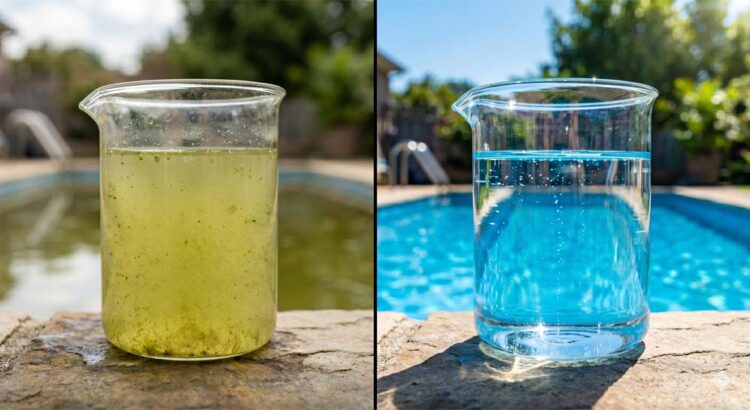
If you own a swimming pool, you are likely familiar with the mid-summer ritual of frustration. The water turns a hazy, suspicious shade of green, so you head to the local pool store, buy the largest, most expensive bucket of chlorine tablets you can find, and dump them into your skimmer. A week later, the water is still cloudy, your wallet is lighter, and the chlorine test strip is giving you readings that make absolutely no sense.
The problem is not that you aren’t using enough chlorine. The problem is that you are treating a complex chemical environment with a one-size-fits-all approach.
As chemists, we do not view your backyard pool merely as a place to cool off; we view it as a dynamic, 20,000-gallon reaction vessel. Everything that enters that water—from UV radiation and rainwater to sweat and sunscreen—alters the chemical equilibrium. To achieve a permanently crystal-clear pool without burning through your maintenance budget, you need to stop buying chemicals blindly and start understanding the active ingredients.

Here is the definitive guide to stopping the cycle of waste and choosing the exact right chlorine for your water’s specific chemical state.
The Chemistry of Clean: Understanding Free Available Chlorine (FAC)
Before we can select the right chemical, we must define what we are actually trying to achieve. When you add “chlorine” to your pool, it reacts with water to form a compound called hypochlorous acid (HOCl) and the hypochlorite ion (OCl-).
Hypochlorous acid is the aggressive, active sanitizer that tears through the cell walls of algae and oxidizes bacteria. This is what we measure as Free Available Chlorine (FAC).
However, as this free chlorine does its job—attacking organic matter like sweat, urine, and algae—it binds to these contaminants and transforms into Combined Chlorine (also known as chloramines). Chloramines are the compounds responsible for that strong, irritating “bleach” smell you often associate with indoor public pools. They cause red eyes, itchy skin, and possess almost zero sanitizing power.
When pool owners see a cloudy pool, they often test for “Total Chlorine.” But Total Chlorine is simply the sum of your Free Chlorine and your Combined Chlorine. You could have a high Total Chlorine reading but zero Free Chlorine, leaving your pool completely unprotected. The goal of pool chemistry is to maximize Free Available Chlorine while keeping Combined Chlorine as close to zero as possible.
The Great Chlorine Divide: Stabilized vs. Unstabilized
The most expensive mistake pool owners make is assuming all buckets of chlorine are created equal. Commercially available pool chlorine is divided into two strict chemical categories: Stabilized and Unstabilized. Using the wrong one at the wrong time is the primary reason pools turn green.
Stabilized Chlorine (Trichlor and Dichlor)
When you buy standard chlorine “pucks” or tablets (Trichlor) or granular shock (Dichlor), you are buying stabilized chlorine. These products are manufactured by binding chlorine to a chemical called Cyanuric Acid (CYA).
Why do this? Because raw, unprotected chlorine is highly susceptible to the ultraviolet (UV) rays of the sun. Without protection, a perfectly chlorinated pool can lose 90% of its free chlorine in just two hours on a sunny afternoon. Cyanuric acid acts as a microscopic sunscreen for your chlorine molecules, allowing them to persist in the water for days rather than hours.
Unstabilized Chlorine (Sodium Hypochlorite and Calcium Hypochlorite)
Unstabilized chlorine contains zero cyanuric acid. The most common forms are liquid pool chlorine (Sodium Hypochlorite, which is chemically identical to household bleach but at a much higher concentration) and powdered Cal-Hypo (Calcium Hypochlorite).
Because they lack the CYA “sunscreen,” these chlorines are highly vulnerable to sunlight. However, they are incredibly fast-acting, making them the absolute best choice for rapidly shocking a pool to clear an algae bloom or oxidize chloramines.
The Silent Killer of Pool Clarity: Cyanuric Acid (CYA) Lock
If stabilized chlorine (Trichlor tablets) protects your sanitizer from the sun, you might assume you should use it exclusively. This is the exact marketing trap that costs homeowners hundreds of dollars a year.
Here is the chemical catch: while chlorine gets used up and dissipates, cyanuric acid never leaves your pool water. It does not evaporate. It does not degrade. The only way it leaves your pool is if water is physically splashed out or drained.
If you rely solely on Trichlor tablets all summer, week after week, you are constantly adding more cyanuric acid into your 20,000-gallon reaction vessel. The ideal CYA range for an outdoor pool is between 30 and 50 parts per million (ppm). But after a few months of heavy tablet use, your CYA levels can easily soar past 100 ppm.
When CYA levels get too high, a phenomenon known as “Chlorine Lock” (or over-stabilization) occurs. The cyanuric acid binds to the free chlorine so tightly that the chlorine can no longer attack algae or bacteria. Your test strips might show a perfectly healthy 5 ppm of free chlorine, yet your water is turning green and cloudy.
At this point, adding more Trichlor tablets is mathematically useless—you are just adding more of the chemical that caused the lock in the first place. You are literally throwing money into a green puddle. The only scientific cure for severe CYA lock is to partially drain the pool, replace it with fresh water to dilute the cyanuric acid, and switch your chemical strategy.
The Chemist’s Protocol: How to Choose Your Chlorine
To maintain a pristine pool on a budget, you must test your Cyanuric Acid levels monthly and adjust your chlorine source accordingly.
Scenario 1: The Spring Opening (Low CYA) When you open your pool, or if you have just refilled it, your CYA levels are likely near zero. This is the perfect time to use Trichlor tablets. The tablets will steadily introduce both the necessary chlorine and the vital cyanuric acid to build up your pool’s UV protection.
Scenario 2: Mid-Summer Maintenance (Optimal CYA) Once your water testing confirms your CYA has reached that goldilocks zone of 30 to 50 ppm, stop using the tablets. Remove the pucks from the floater. To maintain your daily chlorine levels without raising the CYA further, switch to an unstabilized chlorine like liquid Sodium Hypochlorite. You will save money, and your water will remain actively sanitized.
Scenario 3: The Weekly Shock or Algae Outbreak Never use stabilized Dichlor to shock a pool that already has adequate CYA levels. You will spike your stabilizer unnecessarily. Instead, shock your pool at dusk (to avoid UV degradation) using Calcium Hypochlorite (Cal-Hypo) or liquid chlorine. The unstabilized chlorine will rapidly oxidize the organic matter overnight, breaking down the foul-smelling chloramines and leaving you with a crystal-clear pool by morning. (Note: Monitor your Calcium Hardness levels if using Cal-Hypo frequently, as it adds calcium to the water).
Beyond Chlorine: The Crucial Role of pH
Even if you perfectly manage your cyanuric acid and select the exact right chlorine, you can still waste money if you ignore the supporting cast: your water’s pH.
The chemical efficacy of hypochlorous acid (your active sanitizer) is strictly dictated by the pH of the water. At a pH of 7.2, your free chlorine is operating at roughly 66% efficiency. However, if your pH drifts up to 8.0, the chemical equilibrium shifts, and your chlorine drops to a dismal 24% efficiency.
Let that sink in. If your pool water is too alkaline, you are wasting over 75% of the chlorine you put into the water. It is physically present, but chemically impotent. Before you add expensive sanitizers, always use muriatic acid (to lower pH) or sodium carbonate (to raise pH) to lock your water into the ideal 7.2 to 7.6 range.

Conclusion: Work Smarter, Not Harder
Maintaining a crystal-clear swimming pool does not require an advanced degree in chemical engineering, but it does require abandoning the habit of blindly tossing tablets into a skimmer basket.
By understanding the relationship between Free Available Chlorine, the protective but compounding nature of Cyanuric Acid, and the efficiency curves of pH, you reclaim control over your water. Test your CYA levels, buy liquid chlorine when your stabilizer is high, and ensure your pH is always balanced before you sanitize. Stop fighting the chemistry, and start letting it work for you.