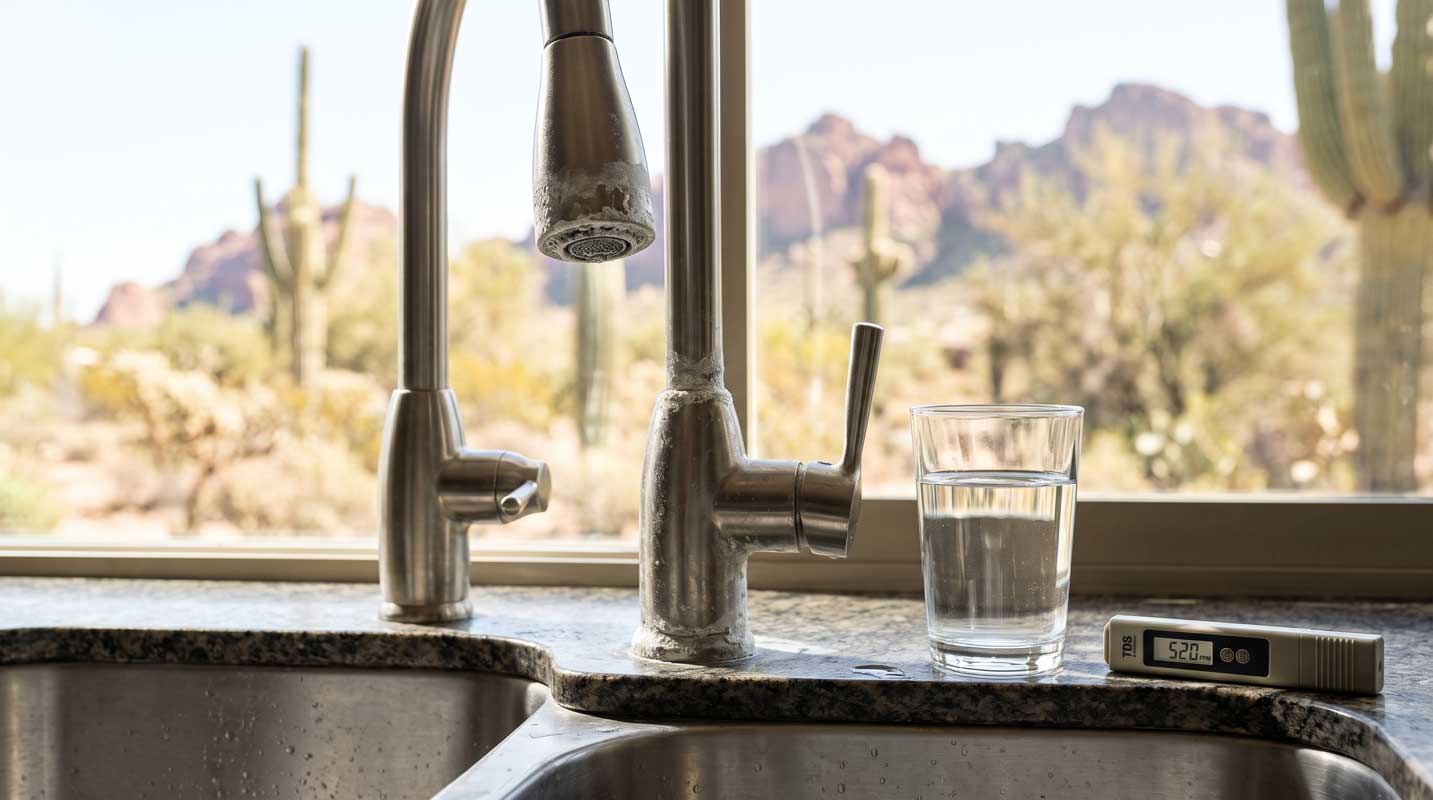
Tap water in Phoenix, Arizona averages 13 to 18 Grains Per Gallon (GPG), or 220 to 310+ Parts Per Million (PPM / mg/L). According to the United States Geological Survey (USGS), any water supply exceeding 10.5 GPG is classified as “Very Hard.” This elevated mineral concentration causes rapid limescale accumulation inside plumbing lines, premature water heater failures, etched glass shower doors, and persistent soap scum across Valley of the Sun households.
Because Phoenix relies on mineral-rich surface water traveling hundreds of miles through desert aquifers and open canals, local homeowners face some of the most aggressive scaling conditions in North America. Addressing these minerals requires a targeted approach based on actual municipal water chemistry rather than generic filtration products.
How Hard is the Water in Phoenix, AZ?
Data compiled from the City of Phoenix Water Services Department’s annual Consumer Confidence Reports (CCR) and regional treatment plants reveals why untreated tap water leaves chalky white residues on every household surface:
- Average Hardness in GPG: 13 to 18 GPG (Citywide average hovers around 15.2 GPG)
- Average Hardness in PPM (mg/L): 220 to 310+ mg/L (measured as CaCO3 equivalent)
- USGS Classification: Very Hard to Extremely Hard (seasonal spikes reach 20+ GPG during peak summer groundwater pumping)
- Average pH Level: 7.6 to 8.3 (Moderately alkaline, which shifts chemical equilibrium toward rapid scale precipitation)
- Total Dissolved Solids (TDS): 420 to 680+ PPM (Exceeds the EPA’s secondary aesthetic recommendation of 500 PPM)
- Free Chlorine Residual: 1.0 to 2.0 PPM (Maintained at higher levels to prevent microbial growth in warm distribution mains)
Phoenix Metro Area Water Hardness Chart
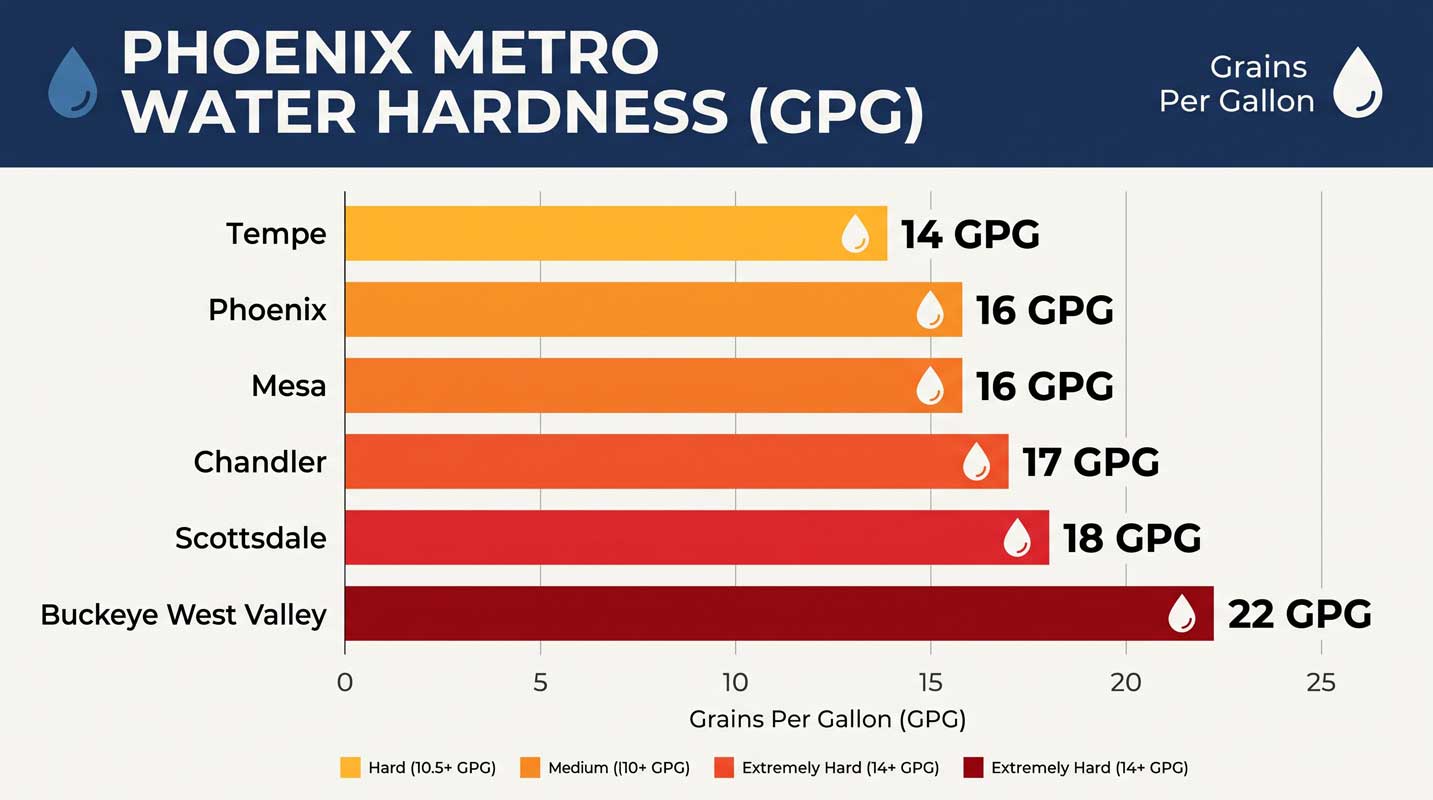
Water quality fluctuates significantly across Maricopa County depending on whether your neighborhood receives treated surface water from the Salt River, Colorado River deliveries, or deep municipal groundwater wells.
| City / Suburb (Valley of the Sun) | Average Hardness (GPG) | Average Hardness (PPM / mg/L) | USGS Hardness Rating | Primary Water Source |
| Phoenix (Central & North) | 13 – 17 GPG | 222 – 290 PPM | Very Hard | SRP Canals & CAP (Colorado River) |
| Scottsdale | 14 – 20 GPG | 240 – 342 PPM | Extremely Hard | CAP Water & Deep Groundwater Wells |
| Mesa | 12 – 18 GPG | 205 – 308 PPM | Very Hard | Salt River, Verde River & CAP |
| Chandler & Gilbert | 13 – 19 GPG | 222 – 325 PPM | Very Hard | SRP Surface Water & Municipal Wells |
| Glendale & Peoria | 14 – 18 GPG | 240 – 308 PPM | Very Hard | CAP Canal, SRP & Local Aquifers |
| Tempe | 12 – 16 GPG | 205 – 273 PPM | Very Hard | Salt River Project (SRP) Surface Water |
| Buckeye & Goodyear (West Valley) | 18 – 25+ GPG | 308 – 427+ PPM | Severely Hard | Heavy Dependence on Alluvial Groundwater |
[Chemist’s Pro Tip]: Municipal water treatment plants in the Valley blend different water sources throughout the year to meet demand. Always program your water softener 2 to 3 GPG higher than your city’s annual average (for example, set a Phoenix system to 18 GPG instead of 15 GPG) to prevent hard water bleed-through during late summer groundwater surges.
Interactive Valley ToolPhoenix Metro Water Softener Sizing Calculator
Select your city and household size to calculate your exact GPG setting & grain capacity.
Municipal range: 13–17 GPG≈ 308 PPMIncludes +2 GPG safety buffer for summer peaks1 Person 5 People 10+ PeopleRecommended System Capacity48,000 GrainsIdeal for 7-day efficient regeneration without hard water bleed-through.Valve Setting 18 GPGDaily Grain Load 5,400 Grains/dayEst. Monthly Salt ~1.2 Bags (40-lb)Chemist’s Note: Because Phoenix tap water contains 1.0–2.0 PPM of chlorine, pair this softener with a 10% cross-linked resin bed and an upstream GAC Carbon Pre-Filter to prevent resin degradation.Check 48,000 Grain Softeners on Amazon →
Why is Phoenix Water So Hard?
Hardness in domestic water is determined strictly by the concentration of divalent metallic cations—primarily dissolved calcium (Ca2+) and magnesium (Mg2+) ions. In Phoenix, three geological and environmental factors drive these ion concentrations sky-high.
1. The Colorado River and Central Arizona Project (CAP)
Roughly 40% of the Valley’s municipal supply originates from the Colorado River, delivered via the 336-mile Central Arizona Project aqueduct. As snowmelt from the Rocky Mountains flows through the Colorado Plateau and canyons carved out of ancient limestone (CaCO3), dolomite (CaMg(CO3)2), and gypsum (CaSO4·2H2O), natural carbonic acid in the water dissolves massive quantities of calcium and magnesium into solution before it ever reaches Lake Havasu or Phoenix treatment facilities.
2. Salt River Project (SRP) and Groundwater Wells
The remaining water comes from the Salt and Verde River watersheds (managed by SRP) and deep alluvial aquifer wells. While mountain runoff starts relatively soft during spring snowmelt, it percolates through mineral-dense desert soil and caliche layers (hardpan calcium carbonate soil common in Arizona). During drought years or peak July–August demand, utilities pump a higher percentage of deep groundwater, which sits in contact with subterranean rock formations for decades and frequently exceeds 20 GPG.
3. Arizona’s Extreme Heat and Retrograde Solubility
Most salts dissolve better as water gets hotter, but calcium carbonate exhibits retrograde (inverse) solubility—meaning it becomes less soluble as temperatures rise. Tap water carries dissolved calcium and bicarbonate ions in a delicate chemical balance. When water enters a Phoenix attic pipe in 115°F summer heat or passes through a water heater set to 120°F–140°F, dissolved carbon dioxide (CO2) gas is driven off, raising the local pH and forcing insoluble rock scale out of solution:

Because Phoenix tap water already leaves the treatment plant at an alkaline pH of 7.6 to 8.3, its Langelier Saturation Index (LSI) is strongly positive. Even slight temperature increases trigger immediate crystallization of solid calcium carbonate (CaCO3) on plumbing interiors.
4 Costly Problems Phoenix Hard Water Causes in Homes
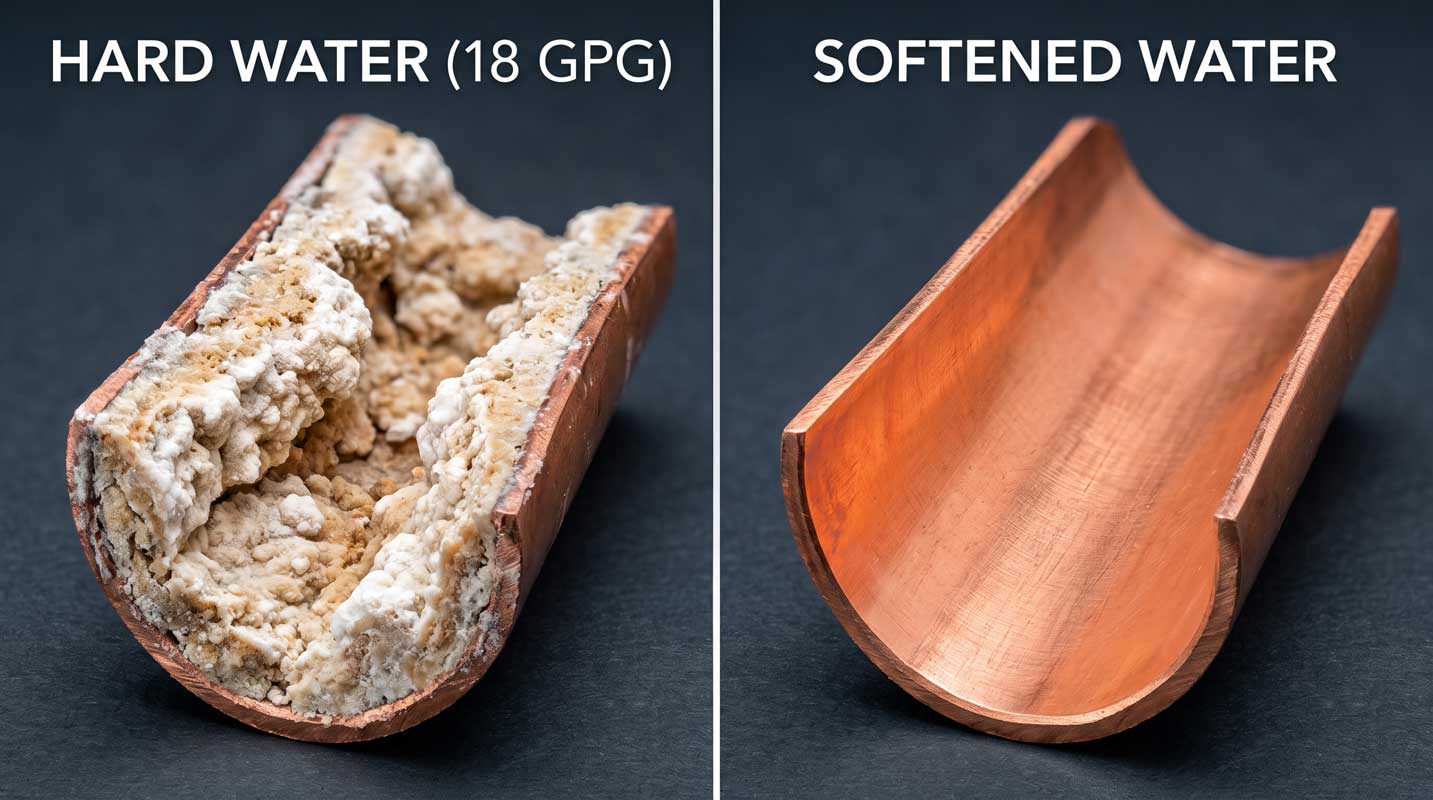
1. Premature Water Heater and Tankless System Failure
In a standard 50-gallon electric or gas tank heater, precipitated CaCO3 settles to the bottom of the tank, forming an insulating rock blanket inches thick. In gas heaters, the burner must superheat the steel tank base through this mineral layer, causing metal fatigue, loud "popping" or rumbling noises (steam bubbles trapped under scale), and tank ruptures within 5 to 7 years. According to studies conducted by the Battelle Memorial Institute, running 15+ GPG water through a water heater reduces thermal efficiency by up to 24% to 29%. For tankless water heaters, narrow heat-exchanger passages clog completely within 12 to 18 months without regular acid descaling.
2. Permanent Glass Etching and Silica Spotting
When droplets of Phoenix tap water evaporate on glass shower enclosures, faucets, and granite countertops, they leave behind every dissolved mineral. Alongside calcium carbonate, Arizona water contains dissolved reactive silica (SiO2). While calcium spots are alkaline and dissolve in mild acids, silica bonds chemically with the silicon dioxide structure of glass. Over time, repeated wetting and drying cycles create microscopic pits known as stage-two glass etching, turning clear glass permanently cloudy.
3. Soap Scum Chemistry and Skin Irritation
Hard water ions react directly with anionic surfactants (fatty acid salts like sodium stearate) found in body washes, bar soaps, and shampoos. Instead of forming a rich cleaning lather, calcium ions displace sodium to form an insoluble gray precipitate known as calcium stearate (soap curd):

This sticky film clings to shower walls and coats human skin and hair shafts. Because insoluble soap curd cannot be rinsed away easily with hard water, it clogs pores, disrupts the skin’s natural acidic mantle (pH ~5.5), exacerbates eczema, and leaves hair feeling straw-like and dull.
4. Stiff Laundry and Appliance Solenoid Failure
During laundry cycles, calcium and magnesium minerals lock into cotton fibers, turning plush bath towels stiff and scratchy while graying white fabrics. Simultaneously, scale crystals build up on rubber solenoid inlet valves inside washing machines, ice makers, and dishwashers, causing slow leaks or premature mechanical burnout.
How to Fix Hard Water in Phoenix, AZ (Solutions by Budget)
1. Whole-House Ion-Exchange Water Softeners (The Permanent Fix)
To physically remove calcium and magnesium ions from a home's supply, you must use a cation-exchange (salt-based) water softener. Inside the pressurized mineral tank, water flows through a bed of sulfonated polystyrene resin beads cross-linked with divinylbenzene (DVB). These negatively charged beads hold a weak electrostatic attraction to positively charged sodium ions (Na+). When Phoenix water passes through the resin, the beads grab the stronger divalent Ca2+ and Mg2+ ions and release Na+ in exchange, delivering 0 GPG water to every faucet.
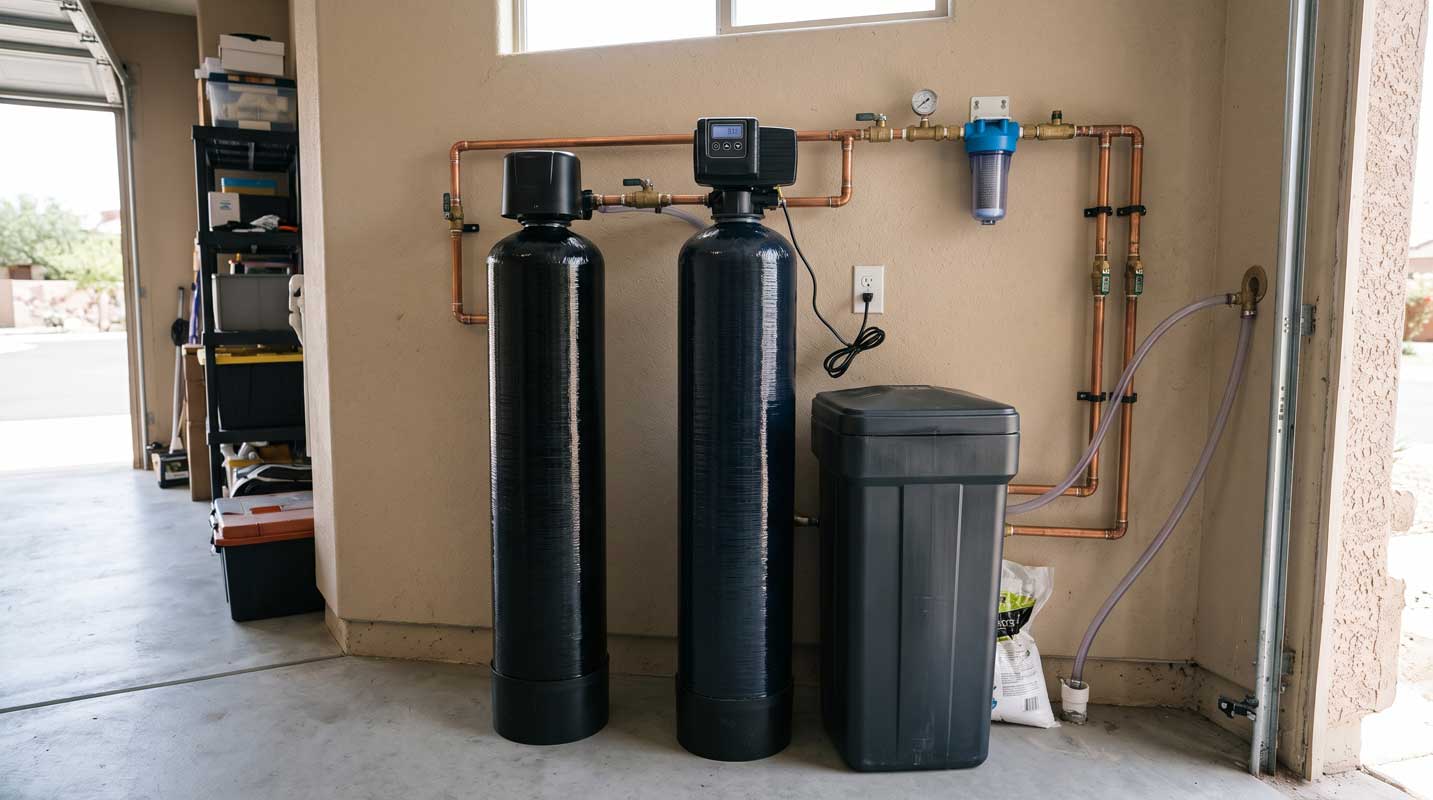
Proper Sizing for Phoenix Homes:
To calculate daily grain load, multiply your household size by 75 gallons per person per day, then multiply by local hardness (18 GPG to include a safety buffer):
- Family of 3–4: 4 people × 75 gal × 18 GPG = 5,400 grains/day. To allow efficient regeneration every 7 days without overworking the control valve, you need a 48,000-grain system.
- Family of 5+ (or homes with multi-head showers/large tubs): Opt for a 64,000-grain capacity unit.
Why Salt-Free "Conditioners" Fall Short in Arizona:
Salt-free systems utilize Template Assisted Crystallization (TAC) to convert dissolved hardness into microscopic sub-micron crystals that resist sticking to pipes. However, TAC does not remove a single grain of hardness. Once water sits stagnant in a hot water tank or evaporates on a black bathroom faucet or glass door, it still leaves white spots, and it provides zero improvement in soap lathering or laundry softness.
2. Why a Carbon Pre-Filter (GAC) is Mandatory in Phoenix
Because water travels through miles of hot underground pipes across the Valley, municipal utilities inject 1.0 to 2.0 PPM of chlorine (or chloramines) to prevent bacterial biofilms. Chlorine is a powerful oxidizer that attacks the divinylbenzene cross-links inside standard 8% water softener resin. Without protection, Phoenix tap water turns softener resin into a mushy gelatinous sludge within 4 to 6 years, causing severe water pressure drops across the house.
Install a standalone Granular Activated Carbon (GAC) catalytic tank immediately upstream of your water softener, and upgrade your softener tank to 10% cross-linked resin. The carbon tank strips out chlorine, pesticides, and summer earthy odors before the water ever touches your softener resin, doubling the lifespan of the softener bed to 12–15+ years.
[Chemist's Pro Tip]: Avoid "all-in-one" mixed-bed tanks that combine carbon and softener resin inside a single vessel. Carbon media exhausts in 4 to 5 years, whereas 10% cross-linked resin lasts over a decade. Separate tanks allow you to re-bed the carbon cheaply without throwing away perfectly good softening resin.
3. Under-Sink Reverse Osmosis (RO) Systems
An ion-exchange softener fixes scale, but it replaces calcium and magnesium with sodium (adding roughly 110–135 mg of sodium per liter at 15–18 GPG) and does nothing to lower Phoenix's high Total Dissolved Solids (450–650+ PPM), sulfates, arsenic traces, or nitrates. Furthermore, every late summer, warm water in SRP and CAP canals triggers blue-green algae blooms that release Geosmin and 2-Methylisoborneol (MIB)—harmless organic compounds that give Phoenix tap water a distinct musty, dirt-like taste.
Installing a 5-stage or tankless Under-Sink Reverse Osmosis (RO) system at the kitchen sink forces softened water through a semi-permeable membrane with a pore size of 0.0001 microns. This strips out 95% to 99% of dissolved salts, added sodium, fluoride, chromium-6, and algal taste compounds, producing bottled-quality drinking water and crystal-clear refrigerator ice cubes. Always place the RO system after the whole-house water softener so calcium scale doesn't foul the expensive RO membrane within 6 months.
4. Budget & Renter-Friendly DIY Hacks (Under $50)
If you rent an apartment in Tempe or Phoenix where plumbing modifications aren't allowed, use targeted chemical solutions to neutralize mineral buildup:
- Citric Acid vs. White Vinegar for Descaling: Standard household white vinegar is only 5% acetic acid CH₃COOH, a weak monoprotic acid that struggles against thick Arizona crust and smells pungent. Food-grade Citric Acid powder (C6H8O7) is a triprotic acid—meaning it has three carboxyl groups capable of donating hydrogen ions and acts as a true chelating agent, wrapping around calcium ions to form highly soluble calcium citrate. Dissolve 2 tablespoons of citric acid powder in a spray bottle of warm water with 3 drops of Dawn dish soap to dissolve shower glass scale three times faster than vinegar without the odor.
- Chelating Hair Care & Shower Filters: Standard KDF-55/carbon showerhead filters remove drying chlorine (which provides immediate relief for itchy skin and color-treated hair), though they cannot remove GPG hardness at 2.5 GPM flow rates. Pair a chlorine-removing shower filter with a weekly chelating shampoo containing Disodium EDTA or Phytic Acid to strip bound calcium and magnesium ions from hair cuticles.
- Dishwasher Citric Acid Booster: Add 1 teaspoon of pure citric acid powder (or a commercial booster like Lemi Shine) to your dishwasher's pre-wash cup every cycle. It neutralizes the high alkalinity of Phoenix water and prevents cloudy film on glassware.
[Chemist's Pro Tip]: Never apply vinegar or citric acid sprays to natural stone surfaces like travertine, marble, or limestone tiles, which are extremely common in Arizona bathrooms. Because natural stone is composed of calcium carbonate (CaCO3), acid cleaners cannot distinguish between water spots and the stone itself—they will permanently etch and dull the polished stone surface in seconds.
Note on Arizona Rebates & High-Efficiency Softeners
Because traditional water softeners discharge sodium chloride brine into the municipal sanitary sewer during regeneration, wastewater reclamation facilities in the desert struggle to lower salinity levels in recycled irrigation water. Old mechanical "time-clock" softeners regenerate every few days on a fixed schedule regardless of whether you used water, wasting thousands of gallons of water and hundreds of pounds of salt annually.
To combat excess brine discharge without banning softeners outright, several East Valley municipalities offer cash incentives for upgrading equipment:
- City of Scottsdale: Offers rebates (up to $250–$500 depending on current fiscal year funding) for removing an inefficient timer-based water softener and replacing it with a certified high-efficiency Demand-Initiated Regeneration (DIR) softener that achieves an efficiency rating of at least 4,000 grains of hardness removed per pound of salt, or for switching to a professional portable exchange tank service.
- City of Chandler: Provides homeowner rebates for installing NSF/ANSI 44 certified high-efficiency metered water softeners.
When shopping for a new system in Maricopa County, ensure the digital control head uses an internal turbine meter (metered/DIR regeneration) and upflow brining technology to minimize salt consumption and qualify for local conservation credits.
Frequently Asked Questions
Is Phoenix tap water safe to drink despite being hard?
Yes, Phoenix tap water meets or exceeds all strict federal health standards enforced by the US Environmental Protection Agency (EPA) under the Safe Drinking Water Act. Dissolved calcium and magnesium minerals are non-toxic and contribute small amounts of dietary minerals. However, because Phoenix water has a high TDS (over 500 PPM), 1.0–2.0 PPM of chlorine, and seasonal organic compounds from canal algae, most residents use carbon filtration or reverse osmosis to improve taste and odor.
What setting should my water softener be on in Phoenix?
Program your water softener control valve between 16 and 18 GPG if you live in Central Phoenix, Tempe, or Mesa, and between 19 and 22 GPG if you live in Scottsdale, Chandler, Gilbert, or the West Valley (Goodyear/Buckeye). For pinpoint accuracy, purchase a $12 Hach 5-B Total Hardness Drop Titration Test Kit, test your cold kitchen tap water before the softener, and add 2 GPG to that exact number to cover seasonal summer mineral spikes.
Do magnetic or electronic descalers work on Phoenix water?
Independent laboratory tests show that clamp-on electromagnetic coils and permanent magnets have negligible impact on 15+ GPG water once it enters a high-temperature environment like a water heater. Because they do not remove calcium ions or alter the water's high pH and alkalinity, scale will still precipitate onto heating elements and evaporate as white crust on plumbing fixtures.
Why does my Phoenix tap water smell like dirt or mold in August and September?
During late summer, intense Arizona sunlight heats the open canals of the Salt River Project (SRP) and Central Arizona Project (CAP), triggering rapid blooms of harmless aquatic cyanobacteria (blue-green algae). These microorganisms release two organic compounds—Geosmin and MIB—which the human nose can detect at concentrations as low as 5 to 10 parts per trillion. Municipal chlorine kills the algae, but a catalytic activated carbon filter or under-sink RO system is required to adsorb the lingering musty taste and odor.